
Bomb-Bay Sorter Implementation: Design, Integration and Best Practices
Bomb Bay Sorter
Definition
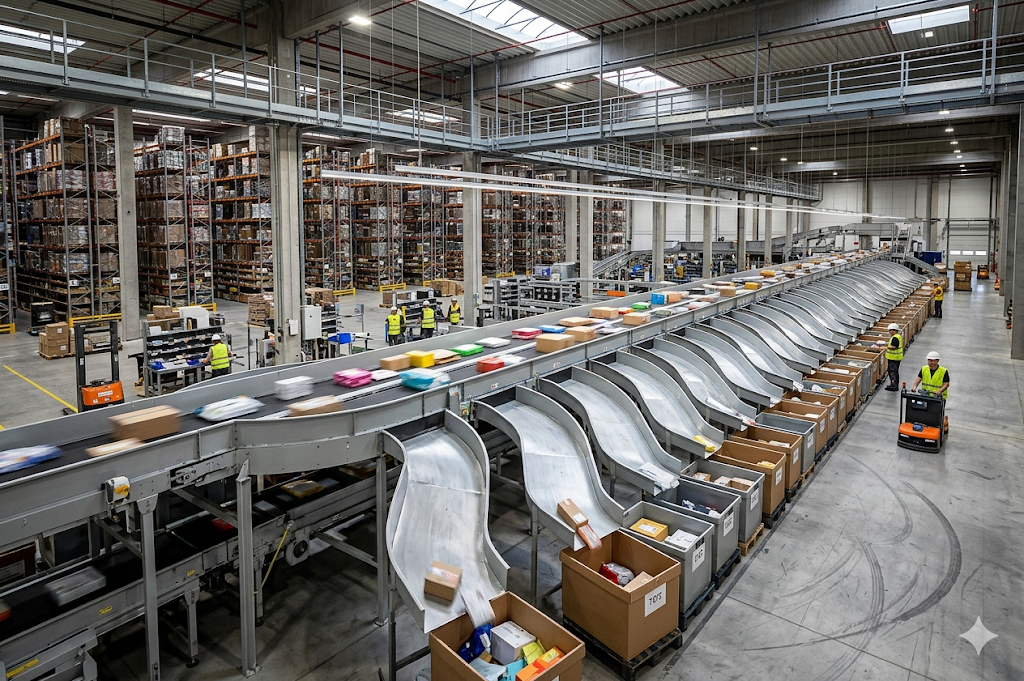
A sorter with tray doors that open downward to drop items into destination containers or chutes.
Overview
Purpose of this guide
This comprehensive guide addresses how to plan, design and implement a Bomb-Bay Sorter in a warehouse, distribution center or postal facility. It covers technological considerations, integration with warehouse management and control systems, physical layout and best practices to achieve reliable, high-throughput sortation.
Project scoping and needs assessment
Begin by quantifying operational requirements: expected daily throughput, peak hourly volumes, number of sort destinations, item profile (dimensions, weight, fragility), target accuracy, and shift patterns. Consider future growth and seasonal variability to avoid under-sizing the system. Sample scoping metrics include average pieces per hour, peak surge multipliers (e.g., 1.5–3x average), and required destinations (sort points).
Selection criteria for sorter configuration
Key selection factors include:
- Throughput capability: choose a model able to handle peak hour loads with margin.
- Carrier design and pocket pitch: ensure pockets accommodate the smallest and largest items safely.
- Actuator type and cycle life: pneumatic vs. electric actuation affects maintenance and control precision.
- Scalability and modularity: modular designs simplify future expansion and minimize downtime during upgrades.
- Vendor support and spare parts: prefer vendors with local service, training and spare parts inventory.
Layout and facility integration
Bomb-Bay Sorters are often installed along a straight or gently curved run.
Considerations include:
- Space for induction conveyors, singulators and scanner stations preceding the sorter.
- Clear vertical and lateral space for chutes and downstream conveyors beneath discharge points.
- Maintenance access corridors and ergonomically located service platforms for technicians.
- Noise and vibration mitigation measures when located adjacent to office or packing areas.
Control, scanning and WMS/TMS integration
Accurate read-and-sort performance depends on reliable scanning at induction and robust sorter control logic.
Best practices include:
- Redundant scanning (primary barcode reader plus secondary OCR/RFID) to reduce read failures.
- Real-time integration with WMS/TMS for routing decisions, manifesting and exception handling.
- Sorter PLC and higher-level controls that support diagnostics, changeover, and dynamic rerouting during lane closures.
- Simulation of sorter behavior using digital twins or discrete-event simulation during the design phase to validate throughput and identify bottlenecks.
Safety, ergonomics and compliance
Ensure all mechanical guards, presence-sensing devices and emergency-stop systems meet local occupational safety standards. Provide training for operators and technicians with clear lockout-tagout (LOTO) procedures. Design chutes and receiving zones to minimize manual handling where possible, and provide ergonomic workstations for any necessary manual intervention.
Testing, commissioning and acceptance
Commissioning should include FAT (Factory Acceptance Test), SAT (Site Acceptance Test), and staged ramp-up. Use representative product mixes during testing to validate read rates, drop accuracy, chute accumulation behavior and downstream handling. Establish acceptance criteria in the contract for metrics such as sort accuracy, uptime percentage and mean time between failures (MTBF).
Operational readiness and training
Create operator and maintenance manuals, run hands-on training sessions, and simulate failure scenarios so staff can practice recovery. Define KPI dashboards for operations teams to monitor throughput, rejects, mis-sorts and scanner read rates in real time. Establish escalation pathways to vendor support for mechanical and software issues.
Cost, ROI and lifecycle planning
Capital costs vary by size, destination count and automation level. Operational savings derive from reduced labor for manual sortation, improved accuracy and faster processing times. Calculate ROI using project-specific assumptions: labor cost avoided, increased throughput revenue, error cost reduction and ongoing maintenance expenses. Account for lifecycle costs including spare parts, routine maintenance, and software updates; plan for major refurbishments at predefined intervals.
Case example
Consider a mid-sized e-commerce fulfillment center required to process 4,000 parcels per hour at peak with 48 sort destinations. A dual-line Bomb-Bay Sorter with redundant induction scanners, electronic actuation and modular chutes can meet throughput expectations while occupying less floor area than an equivalent tilt-tray solution. After commissioning and training, the facility typically reports faster order processing, lower mis-sort rates and a measurable reduction in labor hours per order.
Common pitfalls and mitigation strategies
Common mistakes include underestimating item variability, inadequate scanner redundancy, insufficient spare parts provisioning, and poor chute ergonomics leading to downstream bottlenecks. Mitigations: conduct thorough product profiling, invest in robust scanning hardware and software, maintain a stocked critical-spares inventory and design receiving zones for smooth consolidation.
Conclusion and next steps
Implementing a Bomb-Bay Sorter requires careful alignment of operational needs, mechanical design, control logic and maintenance planning. When chosen and deployed correctly, it provides a cost-effective, compact and high-throughput sortation solution. The recommended next steps are a detailed product mix study, a simulation-based design validation and selection of a vendor with proven domain expertise and strong local service support.
Sources And Additional Reading (3)
- IntelliSort Bomb Bay Sorter
“IntelliSort Bomb Bay Sorter.” Honeywell Intelligrated, https://automation.honeywell.com/us/en/products-backup/warehouse-automation/solutions-by-technology/sortation-systems/bomb-bay-sorter.
- BG Sorter ET Tilt-Tray Sorter
“BG Sorter ET Tilt-Tray Sorter.” BEUMER Group, https://www.beumergroup.com/products-systems/logistics-systems/bg-sorter-et-tilt-tray/.
- Automated Parcel Sortation
“Automated Parcel Sortation.” BEUMER Group, https://www.beumergroup.com/industry/courier-express-parcel/automated-sortation/.
Related Terms
More from this term
Looking for a 3PL?
Compare warehouses on Racklify and find the right logistics partner for your business.