
Bomb-Bay Sorter Operations, Maintenance and Troubleshooting
Bomb Bay Sorter
Definition
A sorter with tray doors that open downward to drop items into destination containers or chutes.
Overview
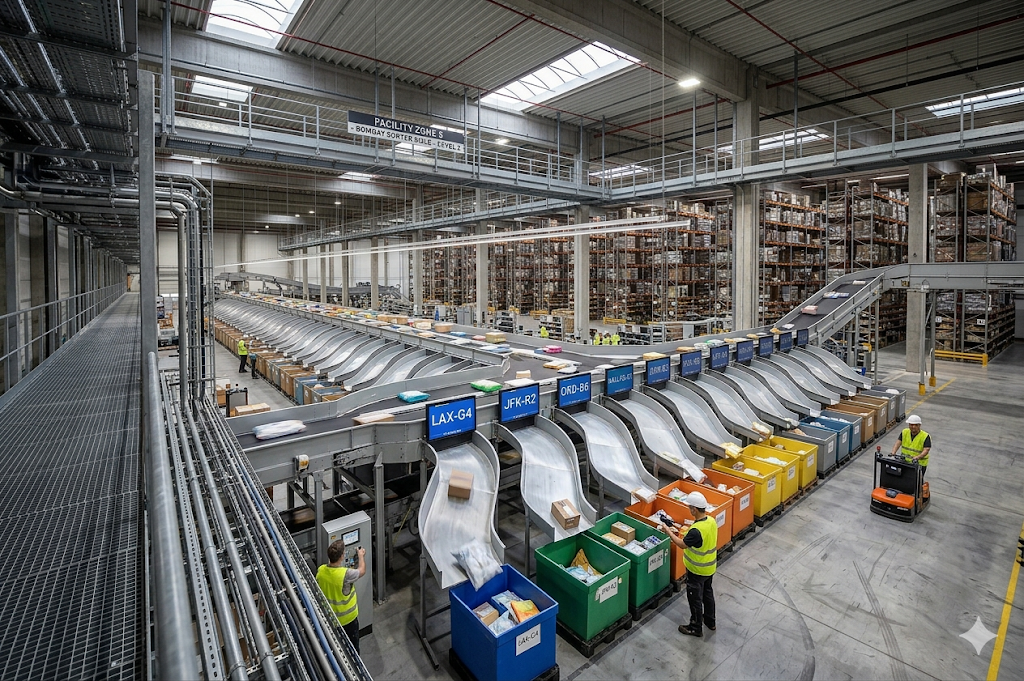
Bomb-Bay Sorter Operations, Maintenance and Troubleshooting
Scope and objectives
This guide focuses on day-to-day operations, preventive maintenance, troubleshooting and continuous improvement for Bomb-Bay Sorters. Reliable performance depends as much on operational discipline and maintenance strategy as on initial design; this entry outlines practical routines, KPIs and diagnostic approaches to keep a sorter operating at peak efficiency.
Daily operational checks and KPIs
Operators should perform standard opening checks at the start of each shift to detect early signs of issues.
Key daily checks include:
- Visual inspection for debris, misaligned chutes or damaged carriers.
- Test runs through induction and a short-sort cycle to validate read rates and door actuation.
- Confirm that scanner lenses are clean and aligned and that light levels meet specifications.
- Verify emergency stops, safety interlocks and guards are functional.
Key performance indicators to monitor continuously include throughput (pieces per hour), sort accuracy (% successful sorts), read rate (% successful reads at induction), downtime (minutes), mean time to repair (MTTR) and mean time between failures (MTBF).
Preventive maintenance program
A robust preventive maintenance (PM) schedule reduces unplanned downtime and extends system life.
Typical PM tasks and frequencies are:
- Daily: clean induction scanners and chutes; remove foreign objects from pocket areas.
- Weekly: inspect belts, chains and carrier hardware for wear; tighten accessible fasteners; check pneumatic lines and fittings.
- Monthly: verify actuator calibration and timing; lubricate bearings and chain drives per vendor specification; exercise all safety devices and sensors.
- Quarterly/annually: perform electrical cabinet inspections, replace wear components (door seals, bushings), and perform full system diagnostics and software backups.
Common failure modes and troubleshooting
Typical issues include:
- Mis-drops or mis-sorts: Often caused by inaccurate scanner reads, timing mismatches, slipped indexing or worn door actuators. Troubleshooting steps: validate scanner read logs, perform carrier-to-chute synchronization tests, and inspect actuator response under load.
- Jams and blockages: Debris in pockets or chutes, oversized items or unstable articles. Mitigations: install trap-doors/clearance access points, enforce item profiling at induction and add reject lanes for non-conforming items.
- Actuator failures: Pneumatic leaks, solenoid failures or mechanical wear. Troubleshooting: check supply pressure and electrical signals, swap suspect actuators with spares to isolate faults, and maintain a small on-site spare pool.
- Scanner/read failures: Dirty optics, damaged cabling or software configuration errors. Troubleshooting: clean optics, verify cable continuity and replace failed sensors; use temporary handheld scanners to maintain throughput during repairs.
Spare parts and vendor relationships
Maintain an inventory of critical spares: actuators, door hinges, chain segments, sensor modules, belts, and common PLC I/O components. A 24–72 hour vendor support SLA is common for critical repairs; negotiate service contracts that include preventive maintenance visits, remote diagnostics and training for in-house technicians.
Software and control considerations
Keep sorter control software and PLC firmware current with vendor-supplied patches to address known bugs and improve diagnostics. Ensure daily backups of PLC logic and sorter configuration. Implement alarm prioritization and centralized logging to speed root-cause analysis. Many operations benefit from remote-monitoring that alerts service teams to anomalous trends (rising actuator cycle times, slipping index events) before failure.
Safety and incident response
Establish clear LOTO procedures for maintenance tasks, and train staff on safe manual removal of jams. Conduct regular safety audits and incident drills. If an incident occurs, document root cause, corrective actions and review prevention measures to avoid repeat events.
Continuous improvement and performance tuning
Use data from KPIs and event logs to identify bottlenecks and recurring fault patterns.
Common continuous improvement actions include:
- Refining induction rules and scanner positioning to improve read rates.
- Adjusting carrier timing or speed profiles to reduce mechanical stress and extend component life.
- Redesigning chutes or adding soft-landing materials where fragile items are discharged.
- Adding temporary buffering or surge lanes to absorb peak spikes without increasing sorter speed beyond safe operating limits.
Environmental and sustainability considerations
Evaluate energy-saving opportunities such as variable-frequency drives on motors, LED lighting and configuring idle modes for non-peak periods. Proper lubrication and preventive maintenance also extend component life, reducing replacement frequency and waste.
Common operational mistakes to avoid
Frequent errors include inadequate product profiling (leading to frequent jams), under-investment in scanner redundancy, insufficient spare part planning, and neglecting scheduled maintenance. Avoid these by enforcing intake standards, investing in robust scanning and controls, and adhering to a documented PM schedule.
Conclusion
Reliable Bomb-Bay Sorter performance is achieved through disciplined operations, a proactive maintenance program and data-driven continuous improvement. By combining practical daily routines, strategic spare parts provisioning and strong vendor partnerships, facilities can maximize uptime, reduce unplanned repair costs and ensure consistent sort accuracy during both normal and peak operations.
Sources And Additional Reading (3)
- IntelliSort Bomb Bay Sorter
“IntelliSort Bomb Bay Sorter.” Honeywell Intelligrated, https://automation.honeywell.com/us/en/products-backup/warehouse-automation/solutions-by-technology/sortation-systems/bomb-bay-sorter.
- Crossbelt Sorter User Manual
“Crossbelt Sorter User Manual.” Interroll, https://www.interroll.com/fileadmin/user_upload/AMERICAS/User_Manuals/6160_6189_Interroll_Crossbelt_Sorter_Horizontal_EN_T.Nr.1103997_V5.3.pdf.
- Automated Parcel Sortation
“Automated Parcel Sortation.” BEUMER Group, https://www.beumergroup.com/industry/courier-express-parcel/automated-sortation/.
Related Terms
More from this term
Looking for a 3PL?
Compare warehouses on Racklify and find the right logistics partner for your business.