
10 Best Amazon Repricing Tools in 2026: Which Ones Are Actually Worth Paying For?
Choosing the right Amazon repricing software can make the difference between winning more sales and unnecessarily sacrificing profit. This guide compares 10 of the best Amazon repricing tools in 2026, including Aura, Seller Snap, BQool, Informed Repricer, Repricer.com and Feedvisor, with current pricing, AI capabilities, marketplace support, strengths and limitations. It also covers free alternatives, honorable mentions and practical strategies for protecting margins while competing for Amazon's Featured Offer.

William Carlin
03 Nov 2026 6:21 PM

10 Best Amazon Repricing Tools in 2026: Which Ones Are Actually Worth Paying For?
Your competitor just lowered their price by 37 cents.
You didn't notice. You were busy running your business.
An hour later, somebody else dropped theirs by 50 cents. By the time you log into Amazon Seller Central, you've lost the Buy Box, your sales have slowed, and three other sellers are now fighting over who can make the least money.
Welcome to selling on Amazon.
Fortunately, you don't need to spend your day staring at competitor prices. That's what Amazon repricing software is for.
But there's a catch.
The best repricers aren't necessarily the ones that lower your prices the fastest. They're the ones that know when to lower prices, when to raise them, and when to do absolutely nothing.
A repricer that wins every sale by destroying your margins isn't doing you any favors.
For this guide, we researched 10 Amazon repricing tools, from inexpensive options for smaller sellers to sophisticated AI platforms designed for businesses managing thousands of SKUs. We also included Amazon's free repricer and several honorable mentions.
The goal is simple: help you pick the software that actually fits your business.
What Is Amazon Repricing Software?
An Amazon repricer automatically adjusts your product prices based on competition, inventory, sales activity and rules you establish.
Imagine you're one of five sellers offering the same product on Amazon.
Your product sells for $29.99. Another seller offers it for $29.49. A third drops to $28.99.
You can manually monitor the listing and decide whether to change your price, or you can let repricing software monitor the competition and make those decisions automatically.
Most repricers work using one of two approaches.
Rule-based repricers follow instructions you create. For example, you might tell the software to price 10 cents below the lowest eligible FBA competitor, but never below $25.
Algorithmic or AI repricers attempt to make more strategic decisions using factors such as competition, sales velocity, historical performance, inventory levels and Buy Box ownership.
More advanced systems may actually raise your prices while you're winning the Buy Box, testing how much additional margin you can capture without sacrificing too many sales.
That distinction matters.
Amazon's Featured Offer, commonly called the Buy Box, is influenced by more than price. Shipping speed, fulfillment reliability and customer service also matter. Amazon explains the factors in its official Featured Offer guide.
Winning the Buy Box at the lowest price isn't always the same thing as maximizing profit.
The 10 Best Amazon Repricing Tools at a Glance
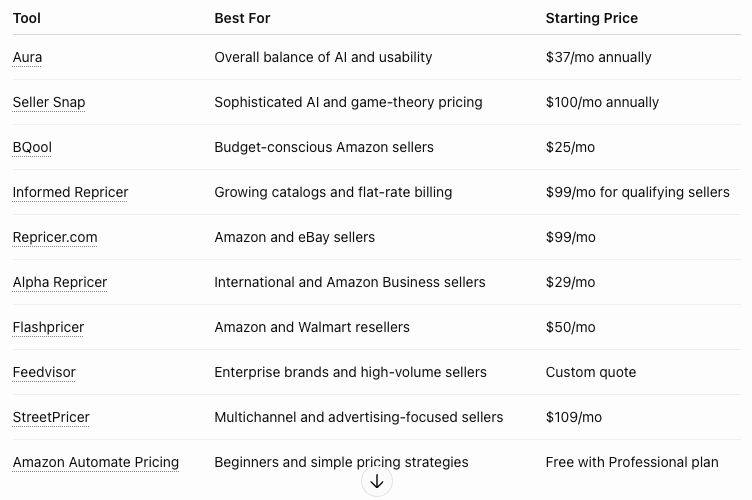
Prices reflect publicly advertised starting plans reviewed for this guide in November 2026. Annual billing, revenue caps, SKU restrictions, additional marketplaces and premium features can significantly change the final cost.
These are editorial recommendations based on documented capabilities, pricing and seller fit, not the results of a controlled hands-on performance test.
1. Aura: Best Overall for Most Growing Amazon Sellers
Aura is one of the more approachable AI-powered repricing platforms available to Amazon sellers.
Its main attraction is that sellers can move beyond simple competitor-matching rules without needing to become experts in pricing algorithms.
Aura's AI engine, Maven, is designed to learn from market conditions and optimize prices rather than blindly undercut competitors.
The platform also supports traditional rules and automated workflows, making it possible to use different strategies across different parts of a catalog.
For example, a wholesale seller could use a competitive strategy on shared ASINs while applying a more conservative margin-focused strategy to products with less competition.
What Makes Aura Interesting?
Aura combines a few important capabilities:
- AI-driven pricing through Maven
- Traditional rules-based repricing
- Automated strategy changes through Workflows
- Minimum and maximum price controls
- Inventory-aware pricing strategies
- Amazon and Walmart marketplace support
- Hyperdrive acceleration for selected listings
- Support for multiple marketplace accounts on higher plans
The ability to combine AI and traditional repricing is particularly useful for sellers who don't want every SKU treated identically.
An aging product might need more aggressive pricing, while a consistently profitable bestseller may benefit from maintaining a higher price.
Aura Pricing
According to Aura's pricing page, annual plans start at:
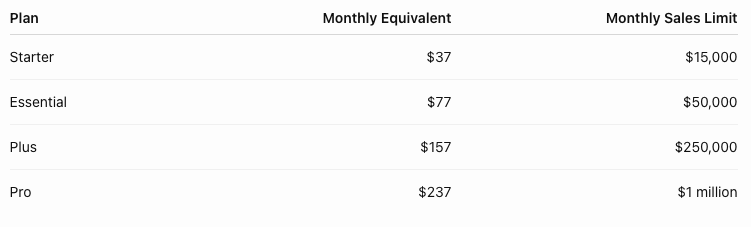
All plans allow unlimited listings, but that doesn't mean unlimited AI repricing.
The Starter plan includes Maven AI on 250 listings, Essential covers 500, Plus covers 1,000, and Pro removes the Maven listing cap.
This is a detail sellers should pay attention to before subscribing.
Where Aura Falls Short
Aura's pricing is tied partly to monthly sales, so the cost of your subscription may increase as your business grows even if your catalog size stays the same.
Maven is also an Amazon-focused AI engine. Walmart repricing uses other supported strategies rather than Maven.
And if you're running an unusually complex multi-account business, you may find more specialized enterprise tools offer greater control.
Who Should Choose Aura?
Aura is a particularly good fit for established FBA sellers, wholesale businesses, and online arbitrage sellers looking to move beyond basic rule-based repricing.
If you have hundreds or thousands of listings and want a relatively approachable AI system, Aura belongs near the top of your shortlist.
Explore Aura's features and pricing.
2. Seller Snap: Best for Advanced AI and Avoiding Price Wars
Seller Snap approaches repricing differently from many traditional competitors.
Its platform emphasizes game-theory-based pricing.
The idea is that pricing doesn't happen in isolation. When you lower your price, competitors react. When they react, you may respond again.
Traditional repricing can create a cycle where sellers repeatedly undercut one another until everyone reaches their minimum price.
Seller Snap's AI attempts to recognize those competitive dynamics and pursue profitable pricing decisions rather than treating every competitor price drop as a reason to immediately respond.
Why Game Theory Matters
Imagine three sellers all offering the same product.
All three have a minimum price of $20, but customers are willing to pay $27.
If everybody uses an aggressive undercutting rule, prices may eventually fall toward $20.
The sellers could end up generating similar order volume while earning substantially less per order.
Seller Snap attempts to evaluate competition more strategically, including situations where maintaining or raising prices may produce better results.
Of course, no algorithm can guarantee that competitors will behave rationally, but the approach is worth considering for heavily contested listings.
Notable Features
Seller Snap offers:
- Game-theory-based AI repricing
- Profit-focused pricing strategies
- Target Buy Box share strategies
- Automated minimum and maximum price calculations
- Competitor and Buy Box analytics
- Inventory and replenishment insights
- Amazon Business repricing on eligible plans
- Walmart repricing on supported plans
- Integration with external inventory and seller-management tools
The platform also includes tools designed to identify pricing opportunities and monitor performance across larger catalogs.
Seller Snap Pricing
Seller Snap's published plans include:
- Starter: $100/month, paid annually, with 1,000 SKUs and up to $15,000 in monthly revenue.
- Accelerator: $250/month, with 1,000 SKUs and up to $30,000 in monthly revenue.
- Standard: $500/month, with 15,000 SKUs and no revenue cap.
- Enterprise: Custom pricing.
Accelerator and Standard offer discounted annual billing.
Seller Snap includes a 15-day free trial.
Where Seller Snap Falls Short
The pricing is harder to justify for a smaller operation.
There are also meaningful SKU and revenue limits on entry plans.
A seller with 5,000 active listings but relatively modest revenue needs to carefully evaluate which tier actually accommodates the business.
Who Should Choose Seller Snap?
Seller Snap is worth considering for established wholesale sellers, large resellers and businesses dealing with significant competition on shared Amazon listings.
It makes the most sense when incremental improvements in average selling price or margin can produce meaningful returns.
3. BQool: Best Budget-Friendly AI Repricer
Not every Amazon seller needs a $250 monthly software subscription.
BQool is a strong option for sellers who want competitive automation without taking on a large fixed expense.
Its Repricing Central product combines AI strategies, traditional rules and conditional repricing.
BQool has also developed tools for Amazon advertising, although the advertising and repricing products are priced separately.
Why BQool Stands Out
The platform gives sellers considerable control over how pricing decisions are made.
You can create different rules for different situations, select the competitors you want to consider, and adjust strategies based on operational factors.
For example, a seller could:
- Increase competitiveness on products with excess inventory.
- Protect margins when inventory is running low.
- Use a different strategy against FBA and FBM competitors.
- Change strategies based on sell-through performance.
- Set a minimum acceptable return on investment.
- Schedule pricing changes around specific conditions.
BQool also integrates with sourcing and inventory tools including SellerAmp, InventoryLab and Boxem.
That makes it particularly relevant for retail and online arbitrage sellers.
BQool Pricing
BQool's pricing is one of its biggest advantages.
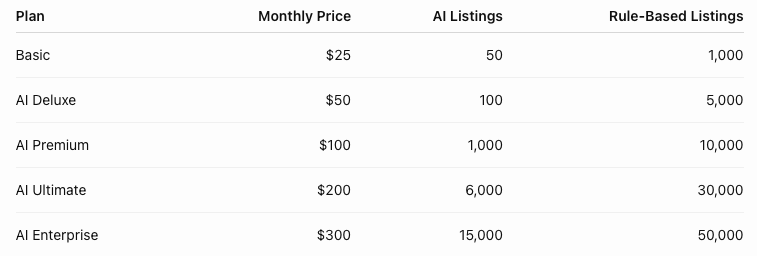
Annual billing offers a 10% discount.
The company also provides a 14-day free trial.
The Catch With BQool
Its entry-level plan is inexpensive, but only 50 listings qualify for AI repricing.
If you have 1,000 competitive SKUs that all need AI strategies, the $25 plan isn't the whole answer.
You also need to account for how BQool charges across different Amazon marketplaces.
North America, Japan and its European marketplace grouping are sold separately according to the company's pricing information.
Who Should Choose BQool?
BQool is a good starting point for sellers with limited budgets, particularly arbitrage and wholesale businesses.
It offers a reasonable path from inexpensive rule-based automation into more advanced AI pricing.
For many smaller sellers, BQool may provide everything they need without paying for a much larger platform.
4. Informed Repricer: Best for Growing Catalogs and Predictable Pricing
Informed Repricer takes an approach that will appeal to sellers tired of subscription plans that become more expensive every time the business grows.
Its Professional plan emphasizes flat-rate billing with unlimited listings and users.
Instead of charging more simply because a seller adds additional SKUs, Informed focuses on advanced pricing strategies and optional upgrades.
What Makes Informed Different?
Informed includes strategies for different competitive situations.
Its tools can attempt to:
- Win and retain the Featured Offer.
- Raise prices while maintaining competitiveness.
- Optimize listings with limited competition.
- Respond to sales velocity.
- Protect minimum margins.
- Adjust pricing based on inventory conditions.
- Support private-label pricing strategies.
The platform also offers Smart Price Reset and Raise the Buy Box Price tools.
These are designed to help sellers avoid allowing their prices to become permanently stuck at an unnecessarily low level.
Informed Pricing
According to its official pricing page:
- Launch: $99/month for qualifying sellers below $5,000 in monthly revenue.
- Professional: $199/month with unlimited listings and users.
- Enterprise: Starting at $499/month.
The company also offers optional upgrades:
- Overdrive: $29/month for accelerated repricing on up to 100 selected listings.
- Overdrive Pro: $49/month for up to 500 selected listings.
- Additional stores: $49/month.
- Business repricing: $49/month.
- Priority support: $49/month.
Informed's standard repricing process typically submits updates in batches within approximately 90–120 seconds. Its Overdrive add-on is designed to support one-second repricing for selected listings.
The Major Advantage
For a business with 10,000, 20,000 or more SKUs, predictable pricing can be valuable.
A flat subscription can be easier to budget than fees based on every listing or transaction.
Where Informed Falls Short
At $199 per month for most established sellers, it is not the cheapest option.
Some of its most appealing acceleration and multistore capabilities also require add-ons.
Who Should Choose Informed?
Informed is particularly attractive for high-SKU sellers, growing wholesale businesses and teams that want strong repricing capabilities without constantly changing subscription tiers as sales grow.
Review Informed Repricer's pricing.
5. Repricer.com: Best for Amazon and eBay Sellers
If your business operates across multiple marketplaces, Repricer.com deserves a close look.
The platform combines fast competitive repricing with advanced pricing strategies and tools for larger multichannel operations.
Unlike software built exclusively for Amazon, Repricer.com directly supports Amazon and eBay repricing, with additional cross-channel capabilities available at higher subscription levels.
What Does Repricer.com Do Well?
Its repricing engine supports a range of competitive strategies, including:
- Competitor-based repricing
- Featured Offer optimization
- Sales-velocity-based pricing
- Price-war management
- Buy Box suppression strategies
- Net-margin repricing
- Stock-level-based strategies
- Automated imports and exports
- Marketplace reporting
Repricer.com also offers tools for Amazon Business repricing and cross-ASIN pricing through optional add-ons.
Pricing and Plan Limits
Repricer.com's pricing currently lists:
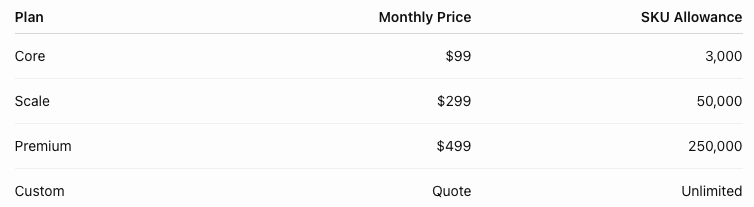
The difference between tiers matters.
Core includes automated repricing, but advanced AI price optimization and Buy Box-focused tools appear on Scale.
Net-margin repricing, the multichannel price replicator and broader API capabilities are listed under Premium.
Where Repricer.com Falls Short
A seller attracted by the $99 entry price might discover that the tools they actually want require the $299 or $499 plan.
Also, marketplace support varies by tier and capability. Don't assume that every supported channel receives identical repricing functionality.
Who Should Choose Repricer.com?
It's particularly well suited to established sellers managing large catalogs across Amazon and eBay, especially those needing sophisticated competitive strategies and integration capabilities.
6. Alpha Repricer: Best for International Amazon Sellers
Alpha Repricer is an interesting option for sellers operating across multiple Amazon countries.
It supports 23 Amazon marketplaces and offers a relatively inexpensive entry point.
One of its strengths is the combination of configurable repricing strategies, international coverage and Amazon Business features.
Features Worth Looking At
Alpha Repricer includes:
- Algorithmic Buy Box Hunter
- Continuous repricing
- Yo-Yo repricing to test higher prices
- Formula-based minimum and maximum calculations
- Sales-velocity and inventory-aware automation
- Competitor filtering
- Scheduled repricing
- Bulk editing and spreadsheet support
- Amazon Business pricing on eligible plans
- Cross-ASIN pricing capabilities
Its Yo-Yo repricing feature is particularly interesting.
Instead of allowing a price to remain at a low competitive level indefinitely, the software can periodically test higher prices within limits you establish.
Alpha Repricer Pricing
Alpha Repricer's plans currently include:
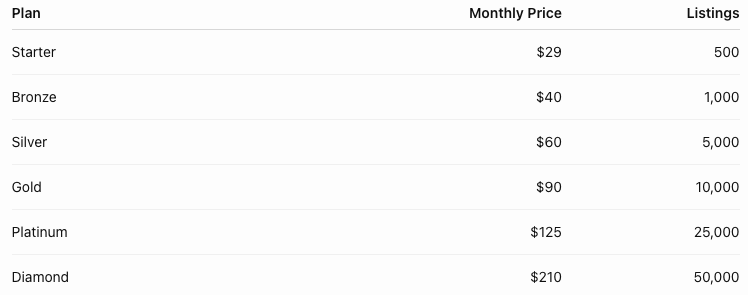
There are also monthly sales limits associated with the plans, and Amazon Business repricing requires an eligible higher-tier subscription.
The company offers a 14-day free trial.
Where Alpha Repricer Falls Short
The entry plan covers only one marketplace, and subscription limits include both inventory size and revenue.
Those details can matter considerably for international sellers.
Who Should Choose Alpha Repricer?
Alpha Repricer is worth evaluating if you operate across numerous Amazon markets or want Amazon Business repricing without moving immediately into enterprise-level software.
Its pricing structure also makes it approachable for sellers testing more advanced automation.
7. Flashpricer: Best for Sellers Using Both Amazon and Walmart
Flashpricer is worth considering for sellers who don't want their pricing strategy confined to Amazon.
The platform supports Amazon and Walmart repricing, including features specifically designed around competitive marketplace pricing.
For sellers expanding from FBA into Walmart Marketplace, that can be particularly useful.
Why Flashpricer Is Different
Flashpricer emphasizes profit-focused repricing rather than permanently chasing the lowest price.
Its advertised capabilities include:
- Fast competitive price updates
- Amazon and Walmart repricing
- AI-powered pricing strategies
- Yo-Yo pricing to test higher prices
- Minimum and maximum price safeguards
- Marketplace-specific competitive rules
- Cross-marketplace price synchronization
- Amazon Business repricing as an add-on
- Private-label price experimentation
The ability to synchronize prices between Amazon and Walmart is particularly interesting.
A seller might want a product's Walmart price to follow a corresponding Amazon price, subject to different marketplace costs and minimum margin requirements.
Flashpricer provides tools designed for those situations.
Flashpricer Pricing
According to Flashpricer, reseller plans begin at $50 per month for one sales channel.
Its brand-focused plans start at $249 per month.
Additional capabilities, including more sophisticated AI optimization, are available on higher tiers.
Amazon Business repricing is advertised as an optional $99-per-month add-on per Amazon sales channel.
Where Flashpricer Falls Short
Although Flashpricer supports advanced capabilities, not every feature comes with the lowest-priced plan.
Its broad positioning also means sellers should carefully evaluate which pricing features are available for Amazon versus Walmart.
Who Should Choose Flashpricer?
Flashpricer is especially interesting for sellers already operating on both Amazon and Walmart, or those preparing to expand beyond Amazon.
8. Feedvisor: Best for Enterprise Amazon Brands
Feedvisor belongs in a different category from most smaller Amazon repricers.
Rather than focusing exclusively on price changes, Feedvisor combines pricing intelligence with advertising, inventory analytics and broader marketplace performance.
The platform is designed for sellers and brands where pricing decisions are connected to much larger operational and marketing strategies.
Beyond Basic Repricing
Feedvisor offers algorithmic pricing for competitive sellers as well as ProductSphere technology for brands that largely control their own listings.
That is an important distinction.
If you own the Buy Box on your own private-label products, repeatedly undercutting other sellers on the same ASIN may not be relevant.
Instead, the problem becomes determining the price at which a product generates the best combination of conversion, margin and revenue.
Feedvisor can incorporate signals such as demand, competitive conditions, inventory, traffic and sales performance.
Its published capabilities include:
- Algorithmic Featured Offer repricing
- Price-elasticity and demand modeling
- Inventory-aware pricing
- Private-label price optimization
- Amazon Business pricing
- MAP controls
- Advertising optimization
- Profitability analytics
- Competitive intelligence
- Managed services and strategic support
For larger sellers, the connection between advertising and pricing can be particularly valuable.
A product's optimal price may depend partly on acquisition cost, conversion rate and advertising spend rather than competition alone.
Feedvisor Pricing
Feedvisor's current product pages describe multiple solutions, including Repricer 360 and broader integrated offerings.
Pricing for the full solution generally requires contacting the company for a quote.
That makes it difficult to compare directly with inexpensive self-service repricers.
Where Feedvisor Falls Short
Feedvisor may be more software than a small or midsize Amazon seller needs.
Its enterprise-oriented capabilities also require a more thorough evaluation of implementation, support and total contract cost.
Who Should Choose Feedvisor?
Feedvisor is best evaluated by mature Amazon businesses with meaningful advertising budgets, complex inventory and enough sales volume for small pricing improvements to justify a larger technology investment.
It is particularly interesting for brands seeking to optimize their overall marketplace economics rather than simply win the Buy Box more often.
Explore Feedvisor's dynamic pricing solutions.
9. StreetPricer: Best for Multichannel Sellers Managing Pricing and Advertising
StreetPricer is another repricing platform worth considering for merchants selling across multiple channels.
It supports repricing for Amazon, Walmart, eBay and Amazon Business, alongside separate capabilities for store pricing and advertising optimization.
What Makes StreetPricer Interesting?
StreetPricer combines traditional marketplace repricing with tools that extend into other areas of ecommerce.
Its offerings include:
- Amazon repricing
- Walmart repricing
- eBay repricing
- Amazon Business support
- Inventory-related pricing controls
- Cross-channel pricing capabilities
- Google Shopping repricing products
- Advertising profit optimization
- Direct-store repricing solutions
That broader approach may appeal to businesses managing pricing across multiple storefronts.
For example, a merchant selling the same products through Amazon, Walmart and eBay may need to account for different fees and fulfillment costs while maintaining a coherent pricing strategy.
StreetPricer Pricing
According to its official pricing page, repricer plans currently include:
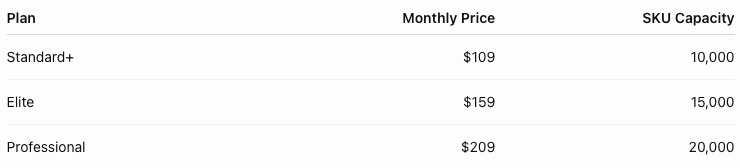
The included number of sales channels and stores varies by plan.
Advertising optimization and other specialized services have separate pricing.
Where StreetPricer Falls Short
Its product lineup is broader than a simple Amazon repricer, which can make determining the right package more complicated.
Sellers only interested in a handful of Amazon SKUs may find less expensive alternatives easier to justify.
Who Should Choose StreetPricer?
StreetPricer is worth evaluating for multichannel sellers who want pricing automation across several marketplaces and may eventually connect pricing decisions with advertising performance.
10. Amazon Automate Pricing: Best Free Repricing Tool
Before spending money on third-party repricing software, take a serious look at what Amazon already gives you.
Amazon Automate Pricing is included with the Professional selling plan.
There is no separate repricing subscription.
For many smaller sellers, that may be enough.
What Can Amazon's Free Repricer Do?
Amazon lets Professional sellers create pricing rules that automatically respond to competitive conditions.
Available rule types include:
- Featured Offer-based pricing
- Lowest-price competition
- Competitive external-price rules
- Sales-based pricing rules
- Amazon Business pricing adjustments
- Minimum and maximum price settings
Sellers can apply rules to selected listings, set limits and pause or modify their strategy when needed.
Amazon says existing rules are generally processed in less than 15 minutes, although timing can vary.
The Advantages
The obvious advantage is cost.
You also avoid paying for another application, and the functionality is built directly into Seller Central.
For a seller managing 20 or 30 moderately competitive products, that might be perfectly sufficient.
The Limitations
Amazon Automate Pricing is primarily a rules-based tool.
It doesn't offer the same breadth of third-party AI strategies, advanced competitor analytics or multichannel optimization found in specialized products.
And because it is relatively easy to configure rules that respond to the lowest price, sellers still need to be careful about creating unnecessary price competition.
Who Should Use Amazon Automate Pricing?
New sellers, smaller catalogs and businesses with straightforward pricing requirements should strongly consider starting here.
There is no reason to pay $200 per month for a repricer if Amazon's included tool already accomplishes everything you need.
Learn how to set up Amazon Automate Pricing.
Honorable Mentions: Five More Amazon Repricers Worth Knowing
The market doesn't stop at ten tools.
Several other repricers deserve consideration, particularly for sellers with specialized requirements.
ChannelMAX
ChannelMAX is an established Amazon repricer offering competitive and algorithmic pricing tools.
Its published plans start at $34.99 per month for 500 SKUs, with larger plans available for much bigger catalogs.
The platform is particularly interesting for sellers seeking detailed repricing controls, Amazon Business functionality and relatively inexpensive high-SKU pricing.
It also provides tools connected to FBA reimbursements and inventory operations.
Profit Protector Pro
Profit Protector Pro combines AI and rules-based repricing with a focus on profit optimization.
The platform offers mobile access, a Chrome extension and strategies designed to raise prices as well as lower them.
Its feature availability and pricing differ by package, including the number of listings eligible for AI repricing and the frequency of updates.
This is an option worth considering for online arbitrage and wholesale sellers who want a relatively hands-on pricing system.
SELLERLOGIC
SELLERLOGIC offers AI and rules-based repricing with international marketplace support.
Its freemium plan currently allows up to 20 optimized products per day.
Paid plans use a product-optimization pricing model, rather than simply charging one flat amount for every seller.
SELLERLOGIC is particularly interesting for European and international sellers, as well as businesses requiring Amazon Business repricing.
RepriceIt
RepriceIt remains one of the least expensive repricing options.
Plans start at $9.95 for up to 500 inventory items, and larger tiers accommodate significantly more products.
The service offers configurable rules, scheduled repricing, minimum prices and FBA support.
It is best suited to sellers who want straightforward, inexpensive automation rather than an elaborate AI pricing platform.
RepricerExpress
RepricerExpress is another established repricing platform, particularly relevant to sellers who prefer a rules-based approach.
It offers customizable pricing rules and support for multiple marketplace operations.
Sellers should compare its current subscription terms with Repricer.com rather than assuming the two products have identical capabilities.
Which Amazon Repricer Should You Actually Choose?
Now for the part that matters.
There is no point paying for advanced game-theory AI if you own a private-label brand with no competing offers on most of your listings.
Similarly, a seller managing 20,000 competitive wholesale SKUs probably shouldn't depend entirely on a basic lowest-price rule.
The right repricer depends on how your business makes money.
If You Sell Through Retail or Online Arbitrage
Your biggest challenges are likely to include rapidly changing competitors, relatively thin margins and managing a large number of unrelated ASINs.
Start by comparing BQool, Aura, Alpha Repricer and Profit Protector Pro.
Pay particular attention to how each system calculates minimum prices and handles FBA competitors.
If You Operate a Wholesale Business
You may have hundreds or thousands of products competing against other authorized or unauthorized resellers.
Consider Seller Snap, Informed Repricer, Repricer.com and BQool.
More sophisticated competitor filtering, MAP controls and margin optimization can be valuable here.
If You Own a Private-Label Brand
Your pricing challenge may be entirely different.
If you are the only seller on an ASIN, winning the Buy Box against other sellers isn't necessarily the problem.
You may instead want to test whether higher prices improve contribution profit, how promotional pricing affects conversion, or when to discount slower-moving inventory.
Feedvisor, Aura and Flashpricer offer capabilities worth investigating for those situations.
Before subscribing, confirm the exact tools available for private-label price optimization rather than assuming every AI repricer is designed for this purpose.
If You Sell on Amazon and Walmart
Start with Aura, Flashpricer, Seller Snap, Informed Repricer and StreetPricer.
All offer relevant cross-marketplace capabilities, but support varies by pricing plan and strategy.
A tool supporting two marketplaces does not necessarily mean the same AI algorithms work on both.
If You Have an Extremely Large Catalog
Informed Repricer, Repricer.com, Feedvisor and higher-tier Seller Snap plans deserve consideration.
For these businesses, ease of bulk management, reporting, integrations and predictable subscription costs can be just as important as the underlying algorithm.
The Most Important Repricing Feature Isn't AI. It's Your Minimum Price.
This deserves its own section because it is where automated repricing can become dangerous.
Every repricer needs a price floor.
But if that floor is calculated incorrectly, the software can follow your instructions perfectly while quietly losing money.
Your actual minimum selling price needs to account for more than the amount you paid your supplier.
Depending on the product and selling model, costs may include:
- Product acquisition or manufacturing
- Inbound freight and duties
- Amazon referral fees
- FBA fulfillment fees
- Storage and inventory-related fees
- Prep and labeling
- Returns and damaged inventory
- Advertising costs
- Other variable expenses
- Your required contribution profit
Amazon provides a Revenue Calculator to help estimate selling and fulfillment costs, although some expenses still need to be entered separately.
An Example of Why Your Price Floor Matters
Imagine you're selling a product for $29.99.
Your economics look like this:
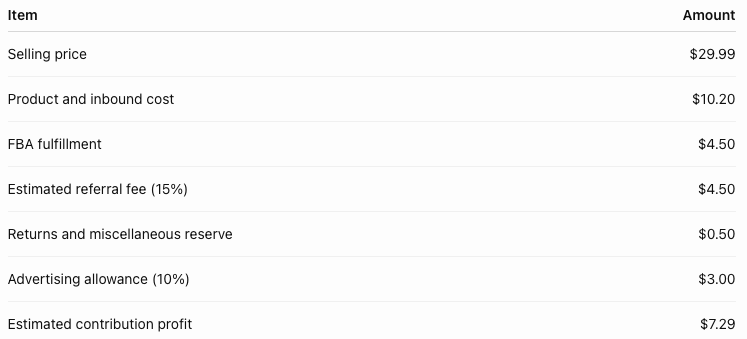
These numbers are hypothetical, not Amazon's fee quote for a specific ASIN.
Now assume a repricer starts chasing competitors downward.
At $25, the product may still generate contribution profit, but considerably less per unit.
At $21, depending on the expense structure, it may no longer support the margin you need.
Your minimum price should therefore be calculated from real costs and desired profitability, not selected because it happens to be a dollar below the competition.
For example, if your fixed variable costs total $15.20 per unit and you want $4 in contribution profit while referral fees and advertising together consume 25% of revenue, your minimum price would be approximately $25.60.
The arithmetic is:
Minimum price = (fixed variable costs + target contribution profit) ÷ (1 − variable percentage fees)
That is a much better starting point than telling software to keep undercutting competitors until it reaches your break-even point.
And remember: the pricing floor is a financial safeguard, not a guarantee that Amazon will accept or prominently display the offer.
Why the Featured Offer Isn't Just About Price
Amazon does not award the Featured Offer solely to the lowest-priced seller.
According to Amazon's Featured Offer guidance, competitive pricing is important, but delivery speed and customer experience also matter.
For FBM sellers, reliable shipping performance can be especially important.
FBA sellers may benefit from Amazon's fulfillment network, but using FBA does not guarantee Featured Offer eligibility.
A repricer also cannot fix poor account health, slow shipping, an inactive listing or insufficient inventory.
Before making your pricing more aggressive, verify whether the product is actually eligible to compete for the Featured Offer.
Sometimes the problem is not price.
Be Careful With MAP and Amazon's Pricing Rules
Brands and authorized resellers often operate under minimum advertised price, or MAP, policies.
If you are subject to an applicable MAP policy, confirm that your repricer can accommodate it and that your configuration is consistent with your contractual and legal obligations.
The other issue is Amazon's own pricing rules.
Amazon's Marketplace Fair Pricing Policy says the company monitors prices and may remove the Featured Offer or take other action when offers appear inconsistent with customer trust.
That can include prices significantly higher than recent prices or problematic shipping charges.
A repricer that automatically raises prices when competition disappears still needs appropriate maximum limits.
The ability to raise your price does not mean every higher price is appropriate.
How to Test an Amazon Repricer Before Committing
Most repricing tools offer free trials, and sellers should use them.
But don't judge a repricer solely by whether sales increased during the first few days.
A system can increase order volume simply by cutting prices.
That doesn't mean it improved your business.
I would evaluate a repricer using the following metrics.
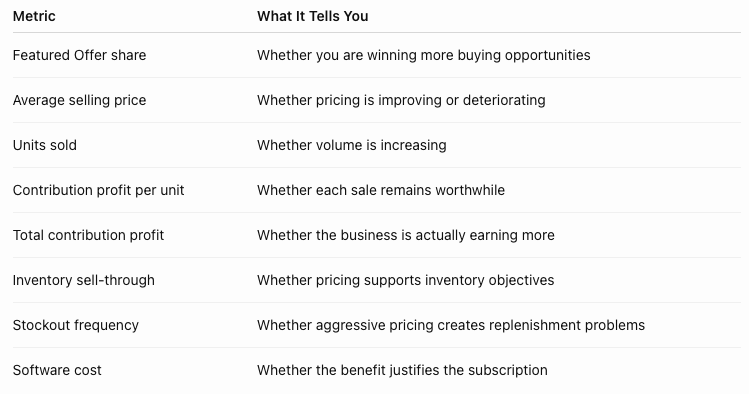
These metrics need to be evaluated together.
For example, if Buy Box ownership increases from 40% to 70% but average contribution profit falls by half, you may not be better off.
Conversely, a repricer that wins fewer orders at substantially better margins might be doing exactly what you want.
A Practical Repricer Testing Process
Start with a controlled group of SKUs that have stable inventory and reasonably consistent demand.
Record current pricing, Featured Offer share, units sold, sales, gross margin and contribution profit.
Then configure the tool with accurate minimum and maximum prices.
Test different strategies on comparable groups of products, avoiding major promotions or unusual inventory changes where possible.
Review performance over several weeks, not merely a few hours.
A 14-day trial can tell you whether the software is usable and functioning correctly, but it may not be enough to establish reliable financial improvement.
If the repricer is producing encouraging results, extend the evaluation and measure the impact on contribution profit after all relevant costs.
Seven Questions to Ask Before Buying Repricing Software
Before committing to any platform, I would ask the provider these questions:
- What is the actual monthly cost for my number of SKUs, sales volume and marketplaces?
- How many listings receive AI repricing on the plan I'm considering?
- How are minimum and maximum prices calculated and updated when costs change?
- What happens when my product is already winning the Featured Offer?
- Can the system recognize differences between FBA, FBM, Amazon Retail and other competitors?
- Does it support the marketplaces and Amazon Business features I actually use?
- Can I export my pricing history, audit changes and easily disconnect the tool?
Also, understand what happens if the software becomes unavailable or loses authorization.
The best automation should reduce your operational risk, not create a new one.
Amazon's Selling Partner Appstore is a useful starting point for reviewing applications that connect to Seller Central.
Final Thoughts: The Best Repricer Is the One That Makes You More Money, Not Just More Sales
Amazon repricing has evolved well beyond lowering your price by a penny every time another seller changes theirs.
Modern tools can react to competition, track inventory, evaluate profit margins, automate pricing strategies and sometimes test whether you can charge more without sacrificing demand.
But the tools serve different businesses.
For smaller sellers, BQool and Amazon Automate Pricing may be all the automation that's necessary.
For growing FBA sellers, Aura offers a compelling balance of AI features and usability.
For heavily competitive wholesale operations, Seller Snap and Informed Repricer are worth a close look.
For large multichannel sellers, Repricer.com, StreetPricer and Flashpricer provide additional flexibility.
And for enterprise Amazon businesses trying to connect pricing with advertising and broader inventory performance, Feedvisor offers a more extensive platform.
The mistake is assuming faster repricing automatically means better repricing.
It doesn't.
A good repricer should protect your margins, respond intelligently to competition and help your inventory move at a profitable pace.
A great repricer should occasionally make you realize you could have been charging more all along.
Subscribe to Racklify News for up-to-date Logistics News & Events
Comments
Share this on Social Media:

Processing Request