
Inside the 140th Canton Fair: A Practical Guide for Ecommerce Buyers and Brands
The 140th Canton Fair is bringing more than 32,000 exhibitors to Guangzhou across 1.55 million square meters of exhibition space from October 15 through November 4. For ecommerce brands, importers and retailers, the show offers access to thousands of manufacturers across electronics, home goods, apparel, consumer products and more. This guide breaks down the three phases of the 2026 show and offers practical tips for navigating the fair, evaluating suppliers and planning the logistics behind a new product.

Jacob Pigon
28 Oct 2026 9:32 AM
Inside the 140th Canton Fair: A Practical Guide for Ecommerce Buyers and Brands
The 140th China Import and Export Fair, better known as the Canton Fair, is underway in Guangzhou, bringing more than 32,000 exhibitors together across one of the largest sourcing events in the world.
The 2026 Autumn Canton Fair runs from October 15 through November 4 at the China Import and Export Fair Complex in Guangzhou. Spread across approximately 1.55 million square meters and more than 75,000 booths, the show covers everything from industrial machinery and electronics to furniture, apparel, pet products, consumer goods and health products.
This year also marks the 70th anniversary of the Canton Fair.
For ecommerce brands, retailers and importers, the scale is both the opportunity and the challenge. Thousands of manufacturers can be evaluated in a matter of days, but arriving without a plan can mean spending most of the show walking instead of sourcing.
The official Canton Fair website provides exhibitor search, product search, maps, appointment scheduling and buyer services that can make the experience significantly easier.
The Canton Fair Is Really Three Different Shows
One of the first things new visitors need to understand is that the Canton Fair is divided into three separate phases.
The exhibitors change between phases, so choosing the right dates matters more than simply deciding to attend the Canton Fair.
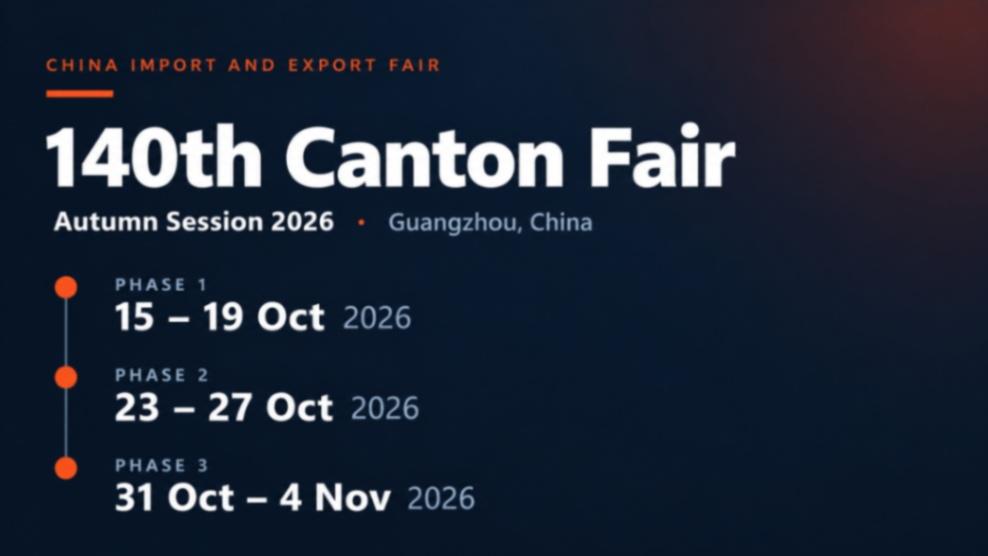
Phase 1 ran October 15–19 and focused on advanced manufacturing. Categories included electronics, appliances, industrial automation, machinery, vehicles and auto parts, new energy, lighting, electrical products, hardware and tools.
Phase 2 runs October 23–27 and focuses heavily on the home. Categories include kitchenware, household products, furniture, home décor, gifts, gardening products, ceramics, building materials and bathroom products.
Phase 3 runs October 31–November 4 and is particularly relevant to consumer brands and ecommerce companies. It includes apparel, footwear, bags, toys, baby products, home textiles, food, personal care, health products, medical devices, sporting goods and pet products.
At the time of publication, Phase 2 is concluding and Phase 3 is the final opportunity to attend the 2026 Autumn session.
Attendance Is Already Running at Record Levels
The first phase alone attracted approximately 189,000 overseas buyers from 214 countries and regions, up 13.3% compared with the equivalent phase of the previous session.
Before the event opened, more than 220,000 overseas buyers from 197 countries and regions had already pre-registered, with professional buyers representing nearly 80% of registrations.
The exhibitor base is also becoming increasingly technology focused.
More than 11,000 participating companies are classified as specialized, innovative or leading businesses within their respective manufacturing categories. Organizers say 64% of exhibitors now use technologies such as artificial intelligence or the industrial internet within their businesses.
That makes the Canton Fair increasingly relevant beyond simply finding the lowest-cost manufacturer.
Brands can use the show to evaluate automation, packaging, product development, customization and manufacturing capabilities alongside traditional sourcing.
How to Navigate the Canton Fair Without Wasting a Day
The biggest mistake a first-time visitor can make is treating the Canton Fair like a normal trade show.
It isn't.
The complex is enormous, and walking booth-to-booth without a plan can quickly consume an entire day.
These are the practical strategies we would recommend for buyers attending the show:
- Build your supplier list before arriving. Use the official Canton Fair buyer platform to search exhibitors and products ahead of time. Identify your highest-priority suppliers and record their booth locations before entering the complex.
- Plan by hall, not just by company. Group suppliers based on where they are physically located. Walking across the complex repeatedly to bounce between appointments is an easy way to lose hours.
- Download the Canton Fair app. The official platform includes exhibitor and product search, appointment scheduling, digital business cards, sourcing requests and onsite navigation. This year's fair also introduced booth-level navigation across the venue.
- Get your buyer badge before the morning you plan to attend. Overseas buyers can pre-register and collect badges through designated registration locations. New applications, replacements and renewals are currently free. Buyers should bring their original qualifying ID, business card and pre-registration QR receipt.
- Have the same questions ready for every supplier. Ask about MOQ, production lead time, sample lead time, pricing tiers, customization, certifications, current export markets and whether the company is the manufacturer or a trading company. Using the same questions makes suppliers much easier to compare later.
- Collect logistics information while you are sourcing. Ecommerce buyers should ask for carton dimensions, units per carton, gross carton weight, product weight, factory location, nearest export port, HS code, pallet configuration and typical production lead time. A product can look inexpensive until freight, duties, storage and fulfillment are added.
- Photograph the booth number before photographing the product. After seeing dozens of suppliers, product photos become almost impossible to match back to the correct company. Take a photo of the booth sign or business card before taking product pictures.
- Don't place an order simply because the booth looks impressive. The fair is an excellent discovery tool, but supplier verification should continue afterward. Request samples, verify certifications when applicable, understand where production actually occurs and consider factory inspections before committing meaningful inventory.
- Use the metro when possible. Guangzhou Metro Line 8 serves the Canton Fair Complex through Xingangdong and Pazhou stations. Pazhou is also accessible through Line 11 and intercity rail. Taxi traffic around the complex can become heavy, particularly when the show closes.
- Do your follow-up every night. Separate suppliers into groups such as high priority, sample requested, needs more research and no fit. Waiting until the end of the trip to organize everything almost guarantees that valuable conversations will get lost.
Treat Sourcing and Logistics as One Decision
For ecommerce companies, one of the most important things to remember at Canton Fair is that product sourcing is only the first half of the equation.
A new product eventually has to move from a factory to a port, clear customs, enter a warehouse and reach a customer.
Understanding packaging dimensions and weights before agreeing to pricing can materially change the economics of a product.
A bulky $10 product may be more expensive to import and fulfill than a $20 product that packs efficiently.
The same applies to MOQs.
Ordering 5,000 units may produce a better manufacturing price, but that discount can disappear quickly if the inventory requires months of additional warehouse storage.
Brands should leave Guangzhou understanding not only what a product costs to manufacture, but what it is likely to cost to land, store, pick, pack and ship.
Use the Fair to Learn, Not Just Buy
Another mistake is approaching every booth with the sole objective of placing an order.
Canton Fair is also an enormous market-research opportunity.
Spend time looking at packaging changes, new materials, product features, automation and categories that appear repeatedly across manufacturers.
Ask suppliers what their fastest-growing export markets are.
Ask what customers are requesting that they weren't requesting a year ago.
Ask which products are seeing falling demand.
Manufacturers often see changes in consumer demand before those trends become obvious elsewhere because they are producing for brands across multiple countries.
For ecommerce operators, that information can sometimes be more valuable than finding another supplier.
Phase 3 Is Particularly Relevant for Ecommerce
For ecommerce brands and fulfillment providers, the final phase may be one of the most interesting portions of the show.
Running October 31 through November 4, Phase 3 covers many categories heavily represented in direct-to-consumer and marketplace ecommerce.
That includes apparel, fashion accessories, shoes, bags, toys, baby and maternity products, home textiles, sporting goods, travel products, food, personal care, health products and pet products.
Those categories also create many of the fulfillment challenges familiar to 3PL operators: high SKU counts, seasonal inventory, returns, kitting, subscription orders, lot tracking and rapidly changing order volumes.
For logistics providers attending Canton Fair, the opportunity is therefore different from that of a traditional buyer.
Thousands of companies at the show are either already exporting internationally or actively attempting to expand overseas. Many will eventually need freight forwarding, customs, warehousing, fulfillment or distribution partners in the markets they enter.
Getting to the Canton Fair
The show is held at the China Import and Export Fair Complex in Guangzhou's Pazhou area.
For most visitors, the metro is the simplest way to reach the complex.
Xingangdong Station on Line 8 provides access to Areas A and D, while Pazhou Station provides access to Areas B and C. Line 11 also serves Pazhou. Visitors arriving by intercity rail can reach the complex through Pazhou Intercity Railway Station.
Guangzhou has also expanded payment options for international visitors, including support for international bank cards in transportation and broader efforts to support foreign cards, cash and mobile payment options during major international events such as Canton Fair.
Visitors leaving near closing time should expect heavier traffic. Local guidance identifies roughly 5:30 p.m. to 7 p.m. as the evening peak around the complex.
Prepare Before You Walk Through the Doors
The Canton Fair remains one of the rare places where a buyer can compare thousands of manufacturers across dozens of product categories within a matter of days.
But scale does not automatically make sourcing easier.
The most effective buyers arrive knowing which halls they need to visit, which suppliers they want to meet and what information they need before making a decision.
Use the fair to discover products and manufacturers, but also pay attention to packaging, production capability, freight economics, compliance and fulfillment requirements.
The goal shouldn't be to leave Guangzhou with the most business cards.
It should be to leave with a short list of suppliers you actually understand.
The 140th Canton Fair continues through November 4, with Phase 3 running October 31–November 4. Buyer registration, exhibitor search, maps and attendance information are available through the official Canton Fair website.
Subscribe to Racklify News for up-to-date Logistics News & Events
Comments
Share this on Social Media:

Processing Request