
The Purr-fect Employees: How Working Cats Keep Warehouses Running Smoothly
Working cats have been a quiet but effective part of warehouse operations for decades, helping control pests, boost morale, and add personality to industrial spaces. From patrolling aisles to supervising dock doors from a safe distance, these feline “employees” play a surprisingly practical role in certain warehouses. While not suitable for every operation, especially highly regulated or automated facilities, warehouse cats remain a charming reminder that sometimes the simplest solutions still work best.

Jacob Pigon
10 Feb 2026 6:00 PM
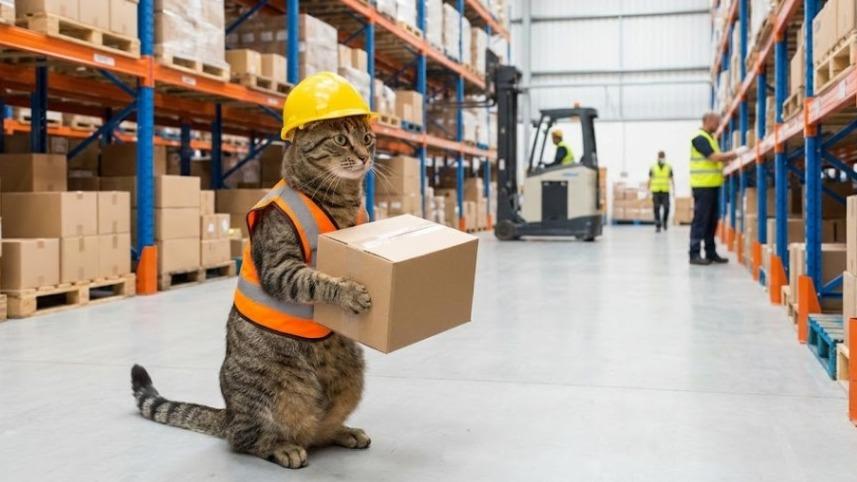
The Purr-fect Employees: How Working Cats Keep Warehouses Running Smoothly
How Working Cats Keep Warehouses Running Smoothly
When people think about warehouse labor, they picture forklifts, conveyor belts, scanners, and steel-toed boots. What they don’t usually picture is a cat perched on a pallet, surveying the operation like they own the place. But in many warehouses around the world, cats are not just mascots. They are legit employees.
Working cats have been quietly keeping warehouses clean, calm, and rodent-free for decades. Long before automation and AI, a good mouser was one of the most effective tools a facility could have. And even today, some warehouses still swear by them.
Why Warehouses Use Cats
At the most basic level, it comes down to pest control. Warehouses store food, packaging, textiles, and products that rodents love. A single mouse problem can lead to damaged inventory, contamination risks, and expensive cleanup.
Cats provide a natural solution. Their presence alone is often enough to keep rodents away. In many cases, it’s not even about hunting. The smell and sound of a resident cat sends a clear message that this is not a safe place for mice.
Unlike traps or poison, cats don’t require constant resetting, don’t introduce chemicals into the environment, and don’t create disposal issues. They just do their thing.
The Unofficial Warehouse Roles Cats Take On
While pest control is the main job, warehouse cats tend to take on a few other “responsibilities” as well.
Some become full-time supervisors, watching over dock activity from elevated vantage points like racking or mezzanines. Others act as morale boosters, greeting employees during shifts and offering quick mental breaks during long days. A few even become social media stars, featured in company posts and holiday cards.
Ask anyone who’s worked in a warehouse with a cat and they’ll tell you the same thing. Productivity doesn’t drop. If anything, the vibe improves.
Not Every Warehouse Can Have One
It’s important to say this clearly. Warehouse cats are not a fit for every operation.
Facilities handling pharmaceuticals, medical devices, or tightly regulated food products usually can’t allow animals on site due to compliance rules. Highly automated warehouses with dense robotics also pose safety risks for pets.
The warehouses that tend to make it work best are older facilities, regional operations, agricultural storage sites, and independent 3PLs that have clear boundaries and designated areas where cats can safely roam.
When it’s done right, cats are vaccinated, spayed or neutered, and cared for like any other working animal. They’re not just dropped into a building and forgotten.
A Tradition That Still Makes Sense
In a world obsessed with cutting-edge logistics technology, there’s something refreshing about the simplicity of a warehouse cat. No software updates. No maintenance contracts. Just instincts, naps, and the occasional patrol.
They’re a reminder that not every problem needs a complicated solution and that sometimes the best workers are the ones who show up, keep watch, and quietly do their job.
Plus, let’s be honest. A cat sitting on a pallet of shrink-wrapped boxes is still one of the most iconic images in logistics.
Whether you call them mousers, mascots, or morale officers, working cats have earned their place in warehouse history. And for cat lovers, it’s proof that even in the most industrial environments, there’s always room for a little fur.
Subscribe to Racklify News for up-to-date Logistics News & Events
Comments
Share this on Social Media:

News
Processing Request