
TikTok Shop Tightens Logistics Rules for U.S. Sellers — Seller Shipping Phased Out in 2026
TikTok Shop is rolling out a major logistics policy change that will reshape how U.S. sellers fulfill orders on the platform. Beginning in early 2026, sellers will be required to use TikTok Shop’s own logistics services or approved ERP and WMS integrations, with seller-managed shipping fully phased out. The move signals TikTok’s push toward tighter control over delivery speed, tracking, and buyer experience, while forcing sellers to reevaluate their fulfillment partners, tech stack, and operational flexibility.

William Carlin
22 Jan 2026 3:50 PM
TikTok Shop Tightens Logistics Rules for U.S. Sellers — Seller Shipping Phased Out in 2026
TikTok Shop is rolling out one of its most consequential operational changes to date, fundamentally altering how U.S. sellers fulfill orders on the platform.
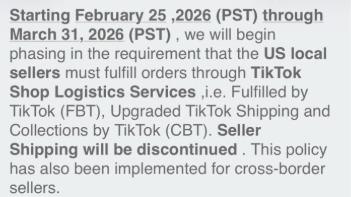
In a notice sent to merchants this week, TikTok confirmed that U.S. local sellers will be required to fulfill orders through TikTok Shop Logistics Services, including Fulfilled by TikTok (FBT), Upgraded TikTok Shipping, and Collections by TikTok (CBT), beginning February 25, 2026, with full enforcement by March 31, 2026. Traditional Seller Shipping will be fully discontinued, and sellers onboarding on or after February 9, 2026 must use TikTok’s logistics tools from day one.
The policy expansion follows earlier cross-border fulfillment requirements and signals TikTok’s continued push toward tighter control of the buyer experience, from checkout to delivery.
What’s Changing and Why Sellers Are Paying Attention
At its core, the update removes sellers’ ability to independently purchase shipping labels or fulfill TikTok orders outside of TikTok’s approved logistics ecosystem. All orders must now flow through TikTok’s Seller Center or an approved integration.
TikTok says the move is designed to improve delivery speed and consistency, reduce fraud and fulfillment disputes, and standardize tracking and post-purchase visibility across the platform.
For sellers, however, the change introduces meaningful trade-offs, particularly around cost control, workflow flexibility, and existing third-party logistics relationships.
Approved ERP, WMS, and Shipping Providers Sellers Can Use
To support the transition, TikTok shared a list of ERP, WMS, and shipping platforms that currently integrate directly with TikTok Shop Logistics. Sellers using these systems can continue operating at scale as long as orders are routed through TikTok’s fulfillment framework.
Approved providers include:
- AfterShip Shipping
- 4Seller ERP
- ECCANG
- LINGXING ERP
- LINGXING WMS
- ShipHero (direct TikTok integration only)
TikTok noted that additional ERP and WMS integrations are in progress, though no timeline has been provided for future additions.
How This Is Affecting Sellers on the Ground
Seller reaction has been mixed. Smaller and newer merchants already using TikTok Shipping or FBT often welcome the simplicity and reduced operational decisions. Larger brands and multi-channel sellers, however, report friction — especially those relying on negotiated carrier rates, custom warehouse workflows, or external shipping software tied to platforms like Shopify or Amazon.
Sellers working with 3PLs are now under pressure to confirm that their fulfillment partners can generate TikTok-approved labels, meet TikTok-defined SLAs, and process orders entirely within TikTok’s logistics framework without disrupting other sales channels.
Many sellers are reassessing whether their current warehouse partners are TikTok-ready or if a more specialized fulfillment provider is needed to support social commerce growth.
What Sellers Should Do Next
With enforcement approaching quickly, sellers should confirm whether their current ERP, WMS, or 3PL supports TikTok Shop Logistics, test order routing and label generation inside TikTok Seller Center, and evaluate fulfillment partners based on TikTok compatibility, not just pricing.
This shift reflects a broader trend in social commerce platforms moving beyond demand generation and into logistics control.
For merchants navigating these changes, platforms like Racklify can help sellers identify TikTok-compatible warehouses and 3PLs, with the ability to filter providers by WMS, ERP, and operational capabilities. That visibility can be especially valuable as TikTok Shop continues tightening fulfillment requirements and sellers look to avoid costly last-minute transitions.
Subscribe to Racklify News for up-to-date Logistics News & Events
Comments
Share this on Social Media:

News
Processing Request